
VIP
Vasoactive Intestinal (VIP) is a 28-amino acid neuro supplied in lyophilized form for in vitro and in vivo research applications. This research-grade enables investigation of VPAC receptor signaling, neuroimmune interactions, smooth muscle regulation, and circadian rhythm mechanisms.
CAS #: 37221-79-7
Availability: In stock
In stock · ships same day
Testing & Quality Assurance+
Testing & Quality Assurance
Trust starts with transparency. Premier Bio Labs subjects every batch to comprehensive third-party testing before release, ensuring the materials powering your research meet pharmaceutical-grade standards.
Complete Batch Testing
Each product includes a Certificate of Analysis (COA) with verifiable data from independent laboratories.
COA Testing Parameters
- Identity Verification – HPLC and Mass Spectrometry confirm molecular structure
- Purity Analysis – HPLC quantification, typically ≥98%
- Concentration Accuracy – Verified dosing levels
- Molecular Weight – Mass spectrometry confirmation
- Endotoxin Screening – LAL assay, <1.0 EU/mg
- pH Testing – Solution stability validation
- Sterility – Microbial contamination screening
- Heavy Metals – Lead, mercury, cadmium analysis
- Residual Solvents – Organic solvent detection
- Moisture Content – Karl Fischer titration
- Physical Inspection – Color, clarity, appearance
- Traceability – Batch numbers, test dates, storage specs
All COAs include methodology, acceptance criteria, actual results, and QC team verification.
Disclaimer & Prohibited Use+
Regulatory & Liability Statement+
VIP
VIP (Vasoactive Intestinal )
Vasoactive Intestinal (VIP) is a 28-amino acid neuro supplied in lyophilized form for in vitro and in vivo research applications. This research-grade enables investigation of VPAC receptor signaling, neuroimmune interactions, smooth muscle regulation, and circadian rhythm mechanisms.
Chemical Specifications:
- Sequence: His-Ser-Asp-Ala-Val-Phe-Thr-Asp-Asn-Tyr-Thr-Arg-Leu-Arg-Lys-Gln-Met-Ala-Val-Lys-Lys-Tyr-Leu-Asn-Ser-Ile-Leu-Asn-NH₂
- Molecular Formula: C₁₄₇H₂₃₇N₄₃O₄₂S
- Molecular Weight: 3326.77 Da
- Structure: 28 amino acids with C-terminal amidation
- CAS Number: 37221-79-7
- Form: Sterile lyophilized white to off-white powder
Molecular Mechanism:
Receptor Targets:
- VPAC1 Receptor (VIP/PACAP receptor type 1) – Gs-coupled GPCR, widely distributed
- VPAC2 Receptor (VIP/PACAP receptor type 2) – Gs-coupled GPCR, tissue-specific expression
- Weak PAC1 binding – Lower affinity than PACAP
Signaling Pathways:
- cAMP/PKA Activation: Primary pathway through Gs coupling
- Vasodilation: Smooth muscle relaxation via cAMP-dependent mechanisms
- Immunomodulation: Anti-inflammatory cytokine regulation (↓TNF-α, ↑IL-10)
- Neuroprotection: BDNF upregulation, anti-apoptotic signaling
Research Context:
VIP was discovered in 1970 as a potent vasodilator . Subsequent research revealed its extensive distribution and pleiotropic functions across multiple organ systems. VIP’s anti-inflammatory and immunomodulatory properties have driven research in autoimmune disease, sepsis, and neuroinflammation models. Its role in circadian rhythm regulation (master clock synchronization in SCN) makes it valuable for chronobiology research.
Certificate of Analysis
This batch has been independently third-party tested. View the full lab report with QR verification.
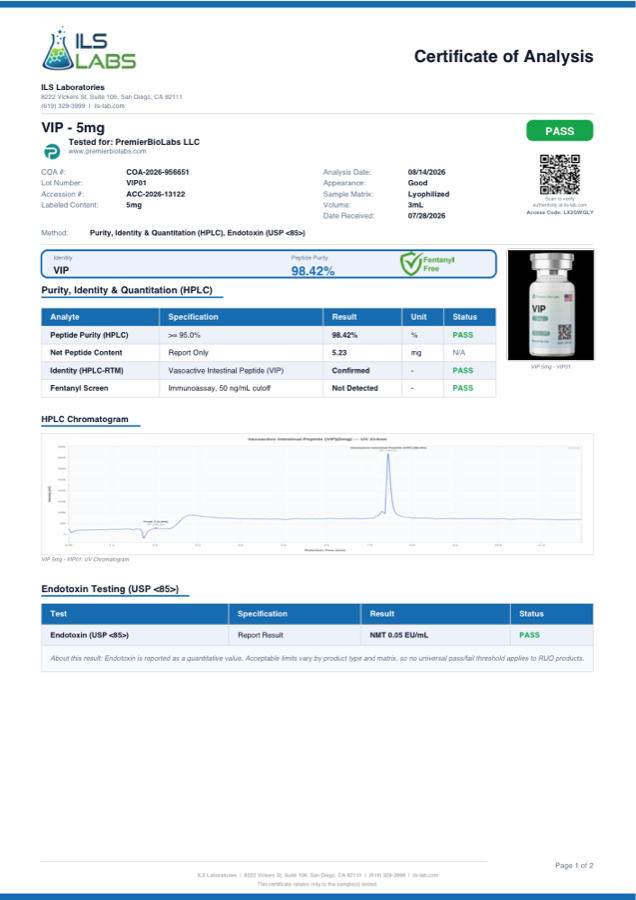
- Dosage5mg
- LotVIP01
- Purity98.42%
- ResultPass